Microsoft Return-to-Workplace: Live · 1,400+ Deployments
A mobile pass and booking app I helped design, now live in 70+ countries.

Role
Core UX Designer
Team
3-Person Core Design Team (Design Director, Visual Designer, Core UX Designer)
Key Partners
Microsoft Global Technology Strategists & Engineering Product Leaders
Global Scale
1,400+ Organizations · 70+ Countries
Core Design Pattern
Modular Multi-Tenant Flow (Facility Selection → Workspace Booking → Daily Pass)
The Challenge: Designing Safe Workplace Re-entry Under Unprecedented Uncertainty
At the onset of the global pandemic, organizations worldwide faced an urgent challenge: how to safely enable essential employees to return to office facilities without an existing playbook or established software tools.
Microsoft tasked our core design team with building an enterprise workplace solution from scratch. The product needed to be extremely direct and intuitive for frontline employees, while remaining modular enough for IT administrators in 70+ countries to customize based on local health regulations and facility layouts.


Design process: mapping the daily-pass user journey across happy and unhappy paths.

Synthesized notes from contextual interviews with 8 pilot users.
RESEARCH PIVOT
The Research Pivot: Listening to Users Under Pressure
During initial stakeholder workshops, the team envisioned a straightforward daily pass request flow. However, when I conducted contextual interviews with 8 pilot users, a crucial insight emerged: users felt unsafe and anxious about returning without knowing where they would be sitting or which facility floor was active.
This research finding fundamentally transformed our user flow architecture. Instead of treating the pass as an isolated credential, I restructured the journey into a connected 3-step sequence:
1. Facility Selection
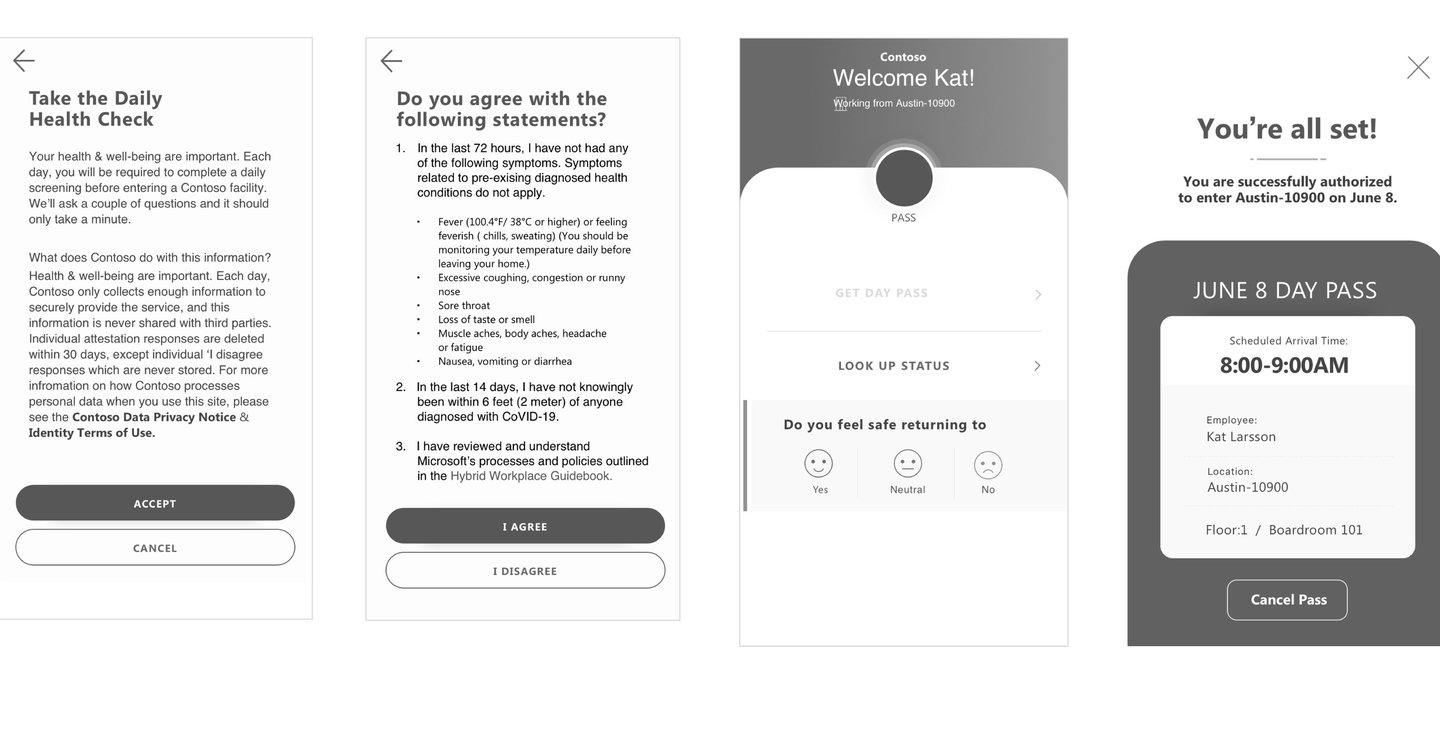
Users select their target building and verify real-time capacity and health protocol status.
2. Workspace Booking
Users reserve a designated, socially-distanced desk or space for their shift.
3. Daily Pass Issuance
Upon completing a health self-attestation, the mobile pass is dynamically generated with embedded facility and desk details.
Validation
We conducted additional user interviews to gather feedback on the designed flows and better understand our users’ needs and challenges.
Scalability & Multi-Tenant UX Architecture
To support 1,400+ diverse organizations—from small single-office companies to multinational enterprises with hundreds of campuses—I designed modular flow templates:
1. Configurable Health Attestations
Form fields that IT admins could easily toggle on/off based on local country laws (EU GDPR vs. US guidelines).
2. Dynamic Facility Maps
Scalable UI patterns supporting single-building passes as well as complex multi-building campus reservations.
3. Accessible Mobile-First Layouts
Built on Fluent Design principles for high contrast, rapid scanning at security checkpoints, and screen reader compatibility.
Wireframes
After multiple user research sessions, it became apparent that our users had pain points. They wanted to select and assign their facility, book workspaces, and obtain a daily pass. We made sure to solve these challenges in the overall daily pass journey. We went through multiple iterations to create high-level and hi-fi wireframes. A set of wireframes below illustrates one flow, specifically the whole process of obtaining a daily pass.


Visual Design
Our Visual Designer developed the design systems for the app and refined our design concept. Because of her well-thought-out design system, I was able to create multiple screens for a broader audience.


Global Impact & Launch Outcomes
After multiple iterations, Microsoft released the Return-to-Workplace app to organizations worldwide.
1,400+ Enterprise Customers
Implemented across major corporations, government agencies, and educational institutions worldwide.
70+ Countries Reached
Scaled globally across North America, Europe, Asia-Pacific, and Latin America.
Microsoft Media Feature
Featured in official Microsoft blogs, press announcements, and technology keynotes.
